Defined Benefit vs Defined Contribution Calculator
Compare defined benefit (DB) and defined contribution (DC) pensions side by side. See how each type projects your retirement income, tax-free lump sum, and total lifetime value based on your salary, service, contributions, and investment assumptions. Make informed decisions about your pension future.
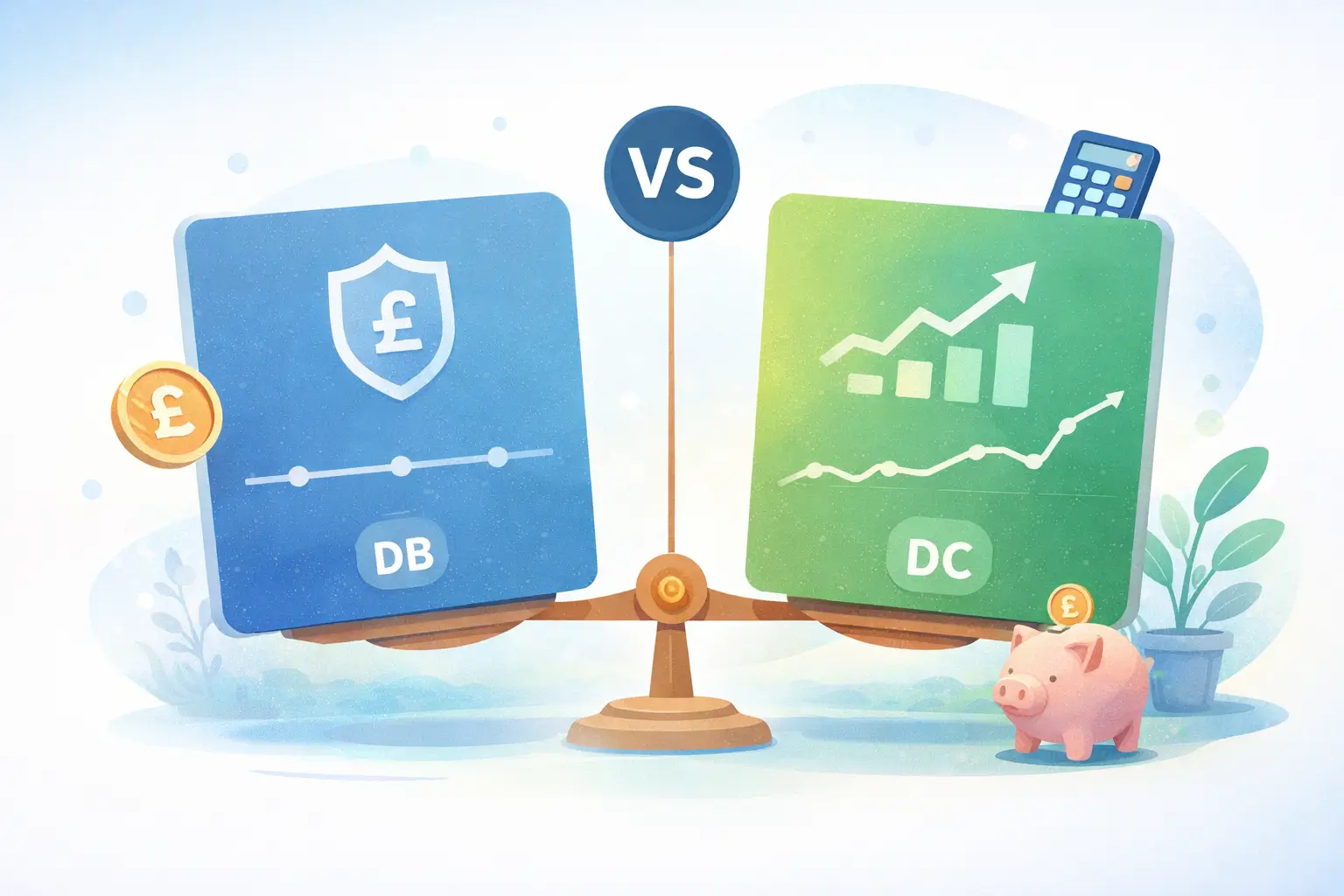
DB vs DC: Which Pension Type Gives You More?
Defined benefit pensions guarantee income for life. Defined contribution pensions build a pot you control. But which delivers more in total? Our calculator projects both side by side using your actual details so you can see the real difference in retirement income, lump sums, and total value over your lifetime.
- Annual Pension:£0/year
- Monthly Pension:£0/month
- Tax-Free Lump Sum:£0
- Pension After Lump Sum:£0/year
- Total Service at Retirement:0 years
- Final/Average Salary Used:£0
- Lifetime Value (to age 85):£0
- Projected Pot at Retirement:£0
- Tax-Free Lump Sum (25%):£0
- Remaining Pot After Lump Sum:£0
- Annual Income (Annuity):£0/year
- Monthly Income (Annuity):£0/month
- Total Contributions Paid:£0
- Lifetime Value (to age 85):£0
| Feature | Defined Benefit (DB) | Defined Contribution (DC) |
|---|
Important Disclaimer
This calculator provides illustrative projections based on your inputs and assumptions about future growth, inflation, and annuity rates. Actual outcomes will differ. DB pension values are guaranteed (subject to scheme rules and PPF protection for funded schemes). DC projections depend entirely on investment performance, which can go down as well as up. This tool does not constitute financial advice. If you are considering transferring between pension types, you should seek advice from an FCA-regulated financial adviser. Transfers from DB to DC are irreversible and you lose guaranteed benefits.
Understanding Defined Benefit vs Defined Contribution Pensions
Defined Benefit (DB)
A defined benefit pension guarantees a set retirement income for life based on your salary and years of service. The employer bears all investment risk. Also known as final salary or career average pensions.
- Income calculated by formula: salary x service x accrual rate
- Guaranteed for life with inflation protection
- Employer responsible for funding
- Common in public sector (NHS, teachers, civil service, LGPS)
- Protected by Pension Protection Fund (funded schemes)
- Cannot run out of money in retirement
- Limited flexibility: set income, restricted death benefits
Defined Contribution (DC)
A defined contribution pension builds a pot of money based on contributions and investment returns. You decide how to access the pot at retirement. Also known as money purchase pensions.
- Pot value depends on contributions + investment growth
- No guaranteed income (unless you buy an annuity)
- You bear the investment risk
- Standard in private sector, auto-enrolment schemes
- Flexible access: drawdown, lump sums, or annuity
- Unused pot passes to beneficiaries (tax-free before 75)
- Risk of running out of money if you live longer than expected
The DB Formula
Defined benefit pensions use a straightforward formula:
Annual Pension = Years of Service x (1 / Accrual Rate) x Pensionable Salary
For final salary schemes, the salary is your pay at or near retirement. For career average (CARE) schemes, each year's earnings are revalued for inflation and the total averaged.
Common Accrual Rates
| Scheme | Accrual Rate | 20 Years on £40k |
|---|---|---|
| NHS 1995 Section | 1/80th + 3x lump sum | £10,000/yr + £30,000 lump |
| NHS 2008 Section | 1/60th | £13,333/yr |
| NHS 2015 Scheme | 1/54th (CARE) | ~£14,815/yr |
| Teachers' Pension | 1/57th (CARE) | ~£14,035/yr |
| Civil Service | 1/49th (CARE alpha) | ~£16,327/yr |
| LGPS | 1/49th (CARE) | ~£16,327/yr |
Investment Risk
In a DB pension, the employer bears all investment risk. Your pension is guaranteed regardless of market performance. In a DC pension, you bear the risk entirely. Poor investment returns mean a smaller pot. Good returns mean more money. This is the single biggest difference between the two types and why DB pensions are considered the gold standard for retirement security.
Flexibility
DC pensions offer far greater flexibility. You can take your pot as drawdown, lump sums, buy an annuity, or any combination. You can vary withdrawals year to year. DB pensions provide a fixed annual income with limited options. Most only allow commuting a portion for a tax-free lump sum. However, flexibility means responsibility: you must manage your own withdrawals to avoid running out of money.
Death Benefits
DC pensions are generally better for death benefits. Unused DC pots can pass to any beneficiary tax-free if you die before 75, or at the recipient's marginal tax rate after 75. DB schemes typically only provide a reduced pension to a spouse or civil partner, and some pay nothing to children once they reach adulthood. If you die with a large DC pot, your beneficiaries inherit it all. With a DB pension, the value dies with you (minus any survivor pension).
Inflation Protection
DB pensions typically increase with inflation (CPI or RPI), protecting your purchasing power throughout retirement. DC pensions have no automatic inflation protection. If you buy an annuity, you can choose an inflation-linked one, but the starting income is lower. If you use drawdown, you must manage withdrawals to account for rising costs. Over a 20-year retirement, 3% inflation halves the real value of a fixed income.
Transferring Between Types
Transferring from DB to DC is possible for funded private sector schemes but not for unfunded public sector schemes (NHS, teachers, civil service). If the transfer value exceeds £30,000, you must take FCA-regulated advice. The FCA and Pensions Regulator believe most people benefit from keeping DB pensions. Transfers are irreversible. Going from DC to DB is generally not possible. Learn more from our Private Pension Calculator.
Tax-Free Lump Sum
Both types allow you to take up to 25% of the pension value as a tax-free lump sum (up to £268,275 under the Lump Sum Allowance). With DC pensions, this is straightforward: 25% of your pot. With DB pensions, taking a lump sum usually means giving up some of your annual income (commutation). Some DB schemes (like NHS 1995) provide an automatic lump sum of 3x pension without reducing the annual income. Use our Tax Relief Calculator for details.
A defined benefit (DB) pension guarantees a set retirement income for life based on your salary and years of service. The employer bears all investment risk. It is also known as a final salary or career average pension. Common in the public sector (NHS, teachers, civil service, LGPS, police, fire service).
A defined contribution (DC) pension builds a pot of money based on your contributions, employer contributions, and investment returns. You choose how to use the pot at retirement: drawdown, lump sums, or annuity. The investment risk is yours. DC pensions are the standard in the private sector, including workplace auto-enrolment schemes and personal pensions like SIPPs.
The fundamental difference is certainty. DB gives you a guaranteed income regardless of markets. DC gives you flexibility but no guarantee. Most financial advisers consider DB pensions the more valuable type, which is why the FCA requires regulated advice before transferring out of a DB scheme worth over £30,000.
DB pensions are generally more valuable for three reasons: guaranteed income for life, inflation protection, and no investment risk. A typical DB pension might provide £15,000-25,000 per year after 25-30 years of service, guaranteed forever. To replicate that income from a DC pot, you would need approximately £300,000-500,000 saved.
However, DC pensions are better in some circumstances: if you have a shorter life expectancy, no dependents who would benefit from a DB survivor pension, want maximum flexibility in how you access your money, or want to pass unused funds to beneficiaries tax-efficiently. DC pots also benefit from potentially higher investment returns if you are comfortable with the risk.
Many people have both types: a DB pension from a public sector career and DC pensions from private sector jobs. This combination provides a solid guaranteed base income (DB) with flexible top-up (DC). Use the calculator above to see how your specific circumstances compare.
For funded private sector DB schemes, yes, you can transfer using the Cash Equivalent Transfer Value (CETV). If the CETV exceeds £30,000, you are legally required to obtain advice from an FCA-authorised pension transfer specialist before proceeding. This advice typically costs £1,500-3,000.
For unfunded public sector DB schemes (NHS Pension, Teachers' Pension, Civil Service alpha, Armed Forces), you cannot transfer to a DC scheme. You can only transfer to another DB scheme. This is because these pensions are funded through taxation, not an investment pot.
The FCA and Pensions Regulator believe that most people will benefit more from keeping their DB pension. Transfers are irreversible: once you move to DC, you cannot go back. You permanently lose the guaranteed income, inflation protection, and employer-backed security. Consider this decision very carefully and always take regulated advice.
DB pensions use the formula: Years of Service x (1/Accrual Rate) x Pensionable Salary.
Final salary example: 25 years at 1/60th with £45,000 final salary = 25 x (1/60) x £45,000 = £18,750 per year for life.
Career average (CARE) example: Each year, you earn 1/54th of that year's salary as pension. If you earn £35,000 for 10 years and £45,000 for 15 years, each year's portion is revalued by CPI + 1.5% (in the NHS 2015 scheme) until retirement, then totalled.
Common accrual rates: NHS 1995 Section = 1/80th (with 3x automatic lump sum), NHS 2008 = 1/60th, NHS 2015 = 1/54th, Teachers = 1/57th, Civil Service alpha = 1/49th, LGPS = 1/49th. Our NHS Pension Calculator and Teacher Pension Calculator provide detailed calculations for these specific schemes.
A widely used guideline is to contribute at least half your age as a percentage from when you start saving. If you begin at 30, aim for at least 15% total (your contribution plus employer). Starting at 22, aim for 11%+.
Under auto-enrolment, the minimum is 8% total (5% employee + 3% employer), but this is widely considered insufficient for a comfortable retirement. The Pensions and Lifetime Savings Association suggests you need approximately £43,100 per year (pre-tax) for a "comfortable" retirement in 2025, which requires a pot of approximately £500,000+ plus State Pension.
A full-time worker contributing just 8% from age 22 to 68 with average investment returns may accumulate a pot providing roughly £10,000-15,000 per year, compared to a DB pension providing £20,000-25,000 for the same salary and service period. This illustrates why DB pensions are considered so valuable. Use our Workplace Pension Calculator to model different contribution levels.
Yes, and many people do. If you have worked in both the public and private sectors, you may have a DB pension from one employer and DC pensions from others. You can also have a personal pension (SIPP) alongside a workplace DB or DC scheme.
Having both types is actually an excellent position: the DB pension provides a guaranteed base income that covers essential expenses, while the DC pot offers flexible top-up income for extras, travel, or unexpected costs. This combination gives you both security and flexibility.
It is important to track all your pensions. Use the government's pension tracing service if you have lost track of old pensions. Our Pension Calculator can help you estimate your total retirement income across all sources.
Understand What Your Pension Is Really Worth
Whether you have a defined benefit pension, a defined contribution pot, or both, understanding the true value of each type helps you plan a secure and comfortable retirement. Use our calculator to see the numbers side by side.