Pension Drawdown Calculator
Plan your flexible retirement income with confidence. Model how long your pension pot will last, calculate tax on your drawdown income, find your sustainable withdrawal rate, and get year-by-year projections — all in one free UK pension drawdown calculator. Updated for 2026/27.
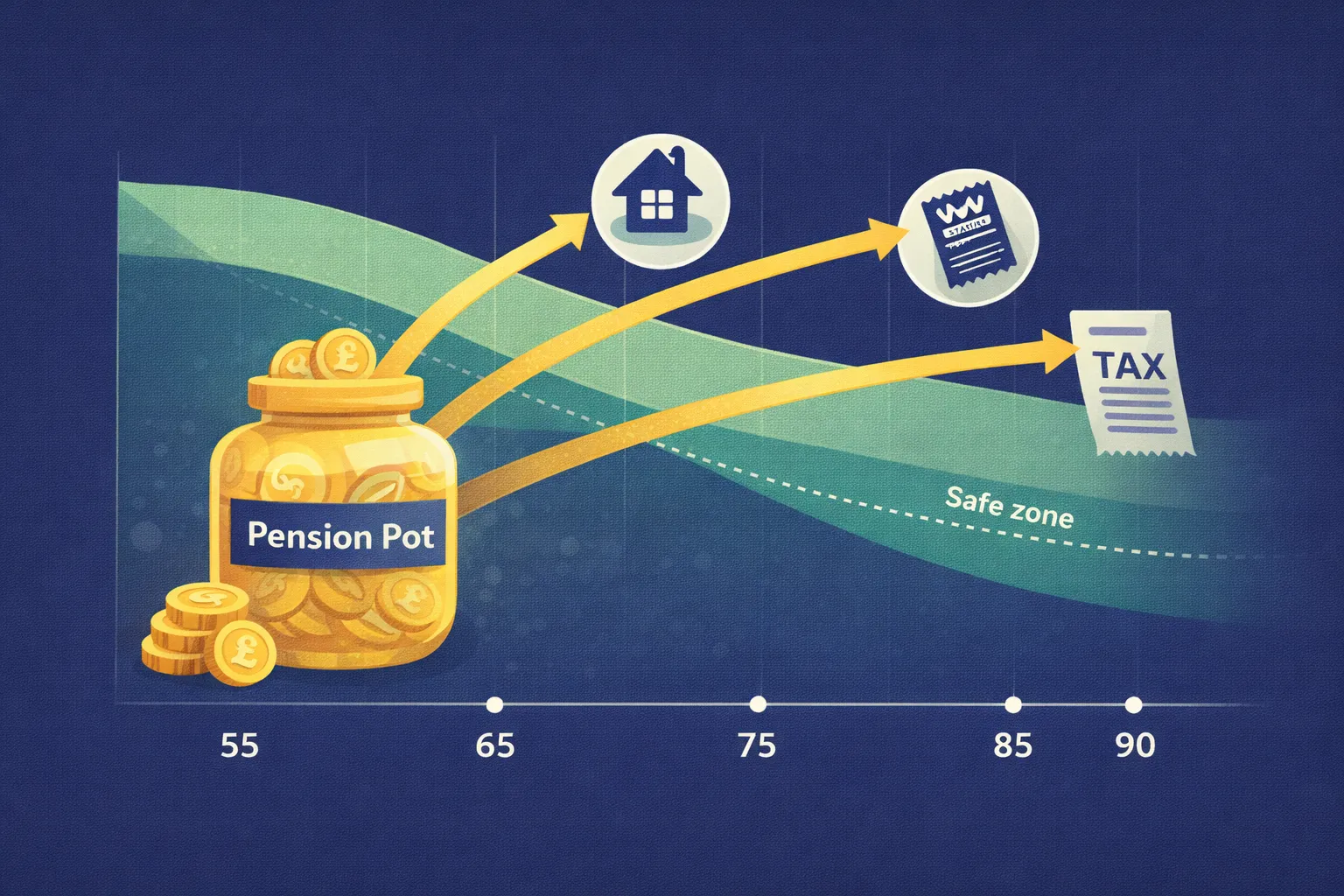
Drawdown: Your Pension, Your Terms
Flexi-access drawdown lets you keep your pension pot invested and withdraw what you need, when you need it. But three questions determine whether your drawdown plan works: How long will my pot last? How much tax will I pay? And am I taking too much too soon? This calculator answers all three.
Pot After Tax-Free Cash
Tax-Free Cash (PCLS)
Annual Net Income
Monthly Net Income
Pot Lasts Until Age
Withdrawal Rate
- Drawdown Income:£0
- Other Income:£0
- Total Taxable Income:£0
- Personal Allowance Used:£0
- Income Tax:£0
- Effective Tax Rate:0%
- Net Drawdown Income:£0
- Annual Withdrawal (gross):£0
- Drawdown Pot:£0
- Annual Growth Rate:0%
- Inflation on Withdrawals:0%
- Years of Drawdown:0
- Pot at Target Age:£0
| Age | Year | Opening Pot (£) | Annual Withdrawal (£) | Investment Growth (£) | Closing Pot (£) |
|---|
About This Calculation
Projections assume a constant annual return and do not model sequencing risk (the impact of poor early returns). Real-world drawdown returns are variable — a bad sequence in early retirement can deplete a pot far faster than projections suggest. Income tax is calculated on 2026/27 rates. This calculator is for planning purposes. For regulated financial advice on your drawdown strategy, consult an FCA-regulated financial adviser or use the free Pension Wise guidance service (free for over-50s).
How Pension Drawdown Works in the UK
Pension drawdown — formally called flexi-access drawdown — is the most popular way to access a defined contribution pension in the UK. It replaced the old "capped drawdown" rules in 2015. Here is how it works at each stage.
Accessing Your Pension
You can start drawdown from age 55 (rising to 57 in April 2028). At this point you "crystallise" some or all of your pension — formally accessing it. You can typically take 25% as a tax-free lump sum (the Pension Commencement Lump Sum, or PCLS), capped at £268,275. The remaining 75% is designated to drawdown, stays invested, and is taxed as income when you withdraw it.
You don't have to crystallise everything at once. Many people crystallise portions over several years to manage their tax position.
Staying Invested
Unlike an annuity, your pot stays invested in your chosen funds after crystallisation. This means it can continue to grow — but also fall. Most drawdown providers offer a range of funds from cautious (mostly bonds and cash) to adventurous (mostly equities). Many retirees adopt a "bucket strategy": keeping 1–2 years of income in cash and the rest invested for growth.
Tax-free growth continues within the drawdown wrapper — there's no income tax on dividends or capital gains inside the pension until you take them out.
Taking Income
Once in drawdown you can withdraw as much or as little as you like, whenever you choose. Withdrawals are taxed as income via PAYE. Your provider applies your tax code — if they don't have the right code they'll use emergency tax, which often results in significant over-taxation on the first payment. You can reclaim this through HMRC.
The moment you take any taxable income (not just the PCLS), the Money Purchase Annual Allowance (MPAA) of £10,000 applies to future contributions — important if you're still working. Use our Pension Tax Calculator to model the full tax position.
The 4% Rule — and Why UK Retirees Should Use 3–3.5%
The "4% rule" originated from US research (the Bengen study, 1994) showing that a 4% initial withdrawal rate, adjusted for inflation each year, survived 95% of 30-year US retirement periods from 1926–1992. It became a shorthand for "sustainable drawdown."
However, UK and global research suggests 3–3.5% is more appropriate for UK retirees for several reasons:
- UK equity markets have historically delivered slightly lower returns than the US
- UK life expectancy means many retirements now exceed 30 years
- UK income tax on drawdown reduces net income, requiring higher gross withdrawals
- Sequence-of-returns risk is particularly acute in the current environment
For a £300,000 drawdown pot, a 3.5% rate implies £10,500/year gross income. Combined with the full new State Pension (approximately £11,973/year for 2026/27), total gross annual income would be around £22,473 — well above the minimum income standard for retirement.
What Affects Your Sustainable Rate?
| Factor | Effect on Sustainable Rate |
|---|---|
| State Pension income | ↑ Higher — less reliance on pot |
| Defined benefit pension | ↑ Higher — guaranteed base income |
| Longer planning horizon (35+ yrs) | ↓ Lower — pot needs to last longer |
| Higher equity allocation | ↑ Higher in long run, but more volatile |
| Poor early returns (sequence risk) | ↓ Lower — devastating early |
| Desire to leave inheritance | ↓ Lower — preserve capital |
| Flexible spending willingness | ↑ Higher — can cut in bad years |
A private pension calculator can help you model pot growth up to retirement alongside your drawdown plan.
Using Your Personal Allowance Every Year
The Personal Allowance (£12,570 for 2026/27) resets each tax year. If your only income is pension drawdown, you can withdraw up to £12,570 tax-free each year. Combined with the 25% PCLS spread over several years via UFPLS (Uncrystallised Funds Pension Lump Sum), each withdrawal is 25% tax-free automatically.
For example, a £50,000 UFPLS in a year with no other income: £12,500 is tax-free (25%), the remaining £37,500 is taxable income. With a £12,570 Personal Allowance, only £24,930 is actually taxed — at 20% = £4,986 tax. Net receipt: £45,014, an effective tax rate of just 9.97%.
For detailed UFPLS calculations, use our dedicated UFPLS Calculator.
Spreading Withdrawals Across Tax Years
Large one-off drawdown withdrawals can push you into higher tax bands (40% above £50,270 or 45% above £125,140). Spreading the same total amount across multiple tax years — even if it's slightly less convenient — can save substantial tax.
Example: Taking £100,000 in one year with no other income would produce approximately £34,460 in tax. Spreading the same amount over two years (£50,000 each) results in approximately £14,920 total tax — saving nearly £20,000. Our Pension Lump Sum Tax Calculator lets you model different scenarios.
Other considerations: withdrawing extra in years before your State Pension begins (to use your full Personal Allowance), and coordinating drawdown with an employed spouse's income or ISA withdrawals (which don't count as income for tax purposes).
The State Pension Impact on Drawdown Tax
The full new State Pension for 2025/26 is approximately £11,973 per year (£230.25/week). It uses up most of your Personal Allowance. Once you're drawing the State Pension, every pound of additional drawdown income is taxed from approximately the first £599 onwards — making tax on drawdown more significant than in pre-State Pension years.
Many people maximise their pension pot drawdown in the years between retirement (age 55–67) and State Pension age (currently 66, rising to 67 by 2028) — using the full Personal Allowance on pension income before the State Pension reduces the remaining tax-free "headroom." Use our State Pension Calculator to estimate your State Pension and factor it into your drawdown plan, and our Retirement Age Calculator to find the optimal timing.
Drawdown vs Annuity: Finding the Right Balance
Drawdown offers flexibility and potential growth but carries investment and longevity risk. An annuity provides guaranteed income for life, removing both risks but sacrificing flexibility and inheritance potential.
A popular hybrid strategy: use part of your pot (often enough to cover essential expenses not met by the State Pension) to buy a guaranteed annuity income, and keep the rest in flexible drawdown for discretionary spending and growth. This gives you a "floor" of guaranteed income while retaining upside.
Current annuity rates (April 2026) are relatively attractive compared to the 2010s, making this hybrid approach more compelling than in recent years. Always compare annuity quotes from multiple providers through an independent broker. Consider our CETV Calculator if you have a defined benefit pension to consider alongside your drawdown planning.
Sequencing risk — also called sequence-of-returns risk — is the most underappreciated danger in pension drawdown. It explains why two retirees with identical pots, identical average returns, and identical withdrawal amounts can have very different outcomes depending on when the good and bad years happen.
Why It Matters
If your pot falls 30% in year 1 of drawdown and you're still withdrawing income, you're selling units at depressed prices to fund withdrawals. Those units are gone permanently — they don't benefit when the market recovers. Conversely, if the same 30% fall happens in year 25 when the pot is much smaller, the impact is far less severe.
A simple example: Two £300,000 pots, both averaging 4% per year over 25 years, both withdrawing £15,000/year. Pot A has bad returns in years 1–5 (averaging -10%/yr) then good returns after. Pot B has good returns first, bad later. Pot A runs out at year 19. Pot B lasts the full 25 years and finishes with £134,000 remaining.
How to Manage Sequencing Risk
- Cash buffer: Hold 1–3 years of income needs in cash so you can avoid selling investments during market downturns
- Flexible withdrawals: Be willing to reduce income in bad market years ("adaptive spending")
- Partial annuity: Guarantee some income so you're not forced to sell investments at any price
- Glide path: Gradually shift from growth to defensive assets as you age
- Part-time work: Even modest earned income in early retirement significantly reduces drawdown pressure when markets are volatile
Key Drawdown Figures 2026/27
- Minimum access age: 55 (rising to 57 in April 2028)
- Tax-free cash (PCLS): 25% of pot, max £268,275
- Personal Allowance: £12,570
- Basic rate threshold: £50,270
- MPAA (once triggered): £10,000/yr contribution limit
- State Pension (full): approx. £11,973/yr (2025/26)
- Lifetime Allowance: Abolished April 2024
- Pension Wise: Free guidance service for over-50s — moneyhelper.org.uk
NHS & Public Sector Workers
NHS staff and teachers typically have a defined benefit (final salary or career average) pension alongside any Additional Voluntary Contributions (AVCs) held in a defined contribution scheme. The DB pension provides guaranteed income in retirement, reducing the need to draw heavily on any DC pot — which can allow a more conservative or growth-focused drawdown strategy. Use our NHS Pension Calculator or Teacher Pension Calculator to understand your DB benefits, then layer drawdown planning on top.
NHS staff who have been affected by annual allowance charges and tapered allowance should also review our Pension Tax Calculator.
Armed Forces Personnel
Members of the Armed Forces receive an index-linked defined benefit pension under AFPS75, AFPS05, or AFPS15 — often from a relatively early age. Any additional personal pension savings could be run in drawdown to complement the guaranteed scheme income. Use our Armed Forces Pension Calculator to understand your scheme entitlement and model how additional DC savings fit alongside it.
Self-Employed & SIPP Holders
Self-employed people typically accumulate their retirement savings through a SIPP (Self-Invested Personal Pension) or personal pension without employer contributions. Drawdown is often the primary retirement income strategy since there is no DB pension. This makes it essential to build a substantial pot and plan withdrawals carefully. Use our Private Pension Calculator to project pot growth, and our Pension Tax Relief Calculator to maximise contributions before retirement.
Defined Benefit Transfer Candidates
Some people consider transferring a defined benefit pension to a SIPP to access drawdown flexibility — particularly if they want to leave pension savings as inheritance or have a shorter life expectancy. Any transfer over £30,000 requires FCA-regulated advice by law. The FCA has found that transfers are rarely in members' best interests. Use our CETV Calculator or Final Salary Transfer Value Calculator to understand what a transfer might involve.
Pension drawdown (flexi-access drawdown) lets you keep your pension pot invested after retirement and take income flexibly, rather than buying an annuity. You can access it from age 55 (rising to 57 in 2028). You take up to 25% tax-free as a lump sum, and the rest remains invested — taxed as income when you withdraw it. You choose how much to take and when.
The key advantage is flexibility and continued investment growth potential. The key risk is that withdrawals combined with poor investment performance can deplete your pot. Use our drawdown calculator above to model your specific situation, and our Pension Tax Calculator for the full tax position.
A sustainable starting point for UK retirees is 3–3.5% of your drawdown pot per year, increased by inflation annually. On a £200,000 pot this means £6,000–£7,000/year from the pension alone — but this would typically be supplemented by the State Pension (approximately £11,973/year if you have a full National Insurance record). Use our State Pension Calculator to estimate your entitlement.
The right rate for you depends on your other income, life expectancy, investment strategy, and willingness to adjust spending. Our calculator above lets you test different rates and see when the pot might run out.
The longevity of your pot depends on three things: your annual withdrawal amount, the investment return your pot achieves, and any inflation-linked increases to withdrawals. As a rough guide, a £200,000 pot withdrawing £10,000/year at 4% net return lasts approximately 32 years; at 2% net return it lasts approximately 26 years; with zero growth, exactly 20 years.
Our pension drawdown calculator's year-by-year projection table shows exactly how your pot reduces (or grows) each year based on your inputs. For professional-grade projections, consider consulting an FCA-regulated financial planner or using the free Pension Wise service.
Yes — taking any taxable income from your pension (including through drawdown) triggers the Money Purchase Annual Allowance, reducing your future pension contribution limit from £60,000 to just £10,000. This matters if you plan to continue contributing to a pension while in drawdown.
Crucially, taking only your 25% tax-free cash (PCLS) and leaving the rest uncrystallised or designating it to drawdown without taking income does NOT trigger the MPAA. If you're still working or have earned income, consult a financial adviser before taking any taxable drawdown, as triggering the MPAA early could cost you significant future tax relief. See our Pension Tax Calculator for the allowance implications.
UFPLS (Uncrystallised Funds Pension Lump Sum) is an alternative to setting up a formal drawdown arrangement. Each UFPLS withdrawal is automatically split: 25% tax-free and 75% taxable income. You don't formally crystallise your pot first — you just take withdrawals and the tax-free portion is included automatically in each payment.
UFPLS is simpler and can be more tax-efficient for smaller pots or occasional large withdrawals. Drawdown is generally better for regular income from larger pots, as you can take the full PCLS upfront and then draw down on the remaining 75%. Use our UFPLS Calculator to compare the tax position of UFPLS against crystallised drawdown for your specific situation.
Yes. Defined contribution pensions in drawdown are currently outside your estate for Inheritance Tax purposes (though the Government announced plans in 2024 to bring pensions into the IHT estate from April 2027 — this is worth monitoring). Any remaining drawdown pot can be passed to beneficiaries who can draw it down as income (taxed at their marginal rate) or take it as a lump sum. If you die before age 75, your beneficiaries can receive the pot completely tax-free. After age 75, it is taxed as their income.
This inheritance potential is a key advantage of drawdown over annuities (which typically end at death, though some have spouse or guaranteed periods). It's one reason many people use a hybrid approach: annuity for essential income, drawdown for discretionary spending and legacy.
Sequencing risk is the danger of experiencing poor investment returns in the early years of retirement while taking withdrawals. If markets fall sharply in year 1–3 of drawdown, you're selling units at low prices to fund income — permanently reducing your pot's ability to recover. The same average return achieved in a different order (poor years later rather than early) can result in a dramatically better outcome.
Strategies to mitigate sequencing risk include: holding a cash buffer (1–3 years of income), using flexible spending (reducing withdrawals in bad markets), partial annuitisation (to guarantee some income), maintaining part-time work in early retirement, and choosing a more defensive investment allocation in the initial drawdown years.
Pension Wise (part of MoneyHelper) offers free, impartial guidance on pension options at retirement for anyone aged 50+. You can book an appointment online at moneyhelper.org.uk or call 0800 138 3944. This is government-backed guidance, not regulated financial advice.
For regulated financial advice — particularly for complex situations involving large pots, defined benefit transfers, or drawdown strategy — you'll need an FCA-regulated financial adviser. Find one at fca.org.uk or unbiased.co.uk. Always check an adviser is on the FCA register before engaging them. Be alert to pension scams — check the FCA ScamSmart warnings.
Pension Tax Calculator
Model tax relief on contributions and tax on pension withdrawals — the full picture.
CalculatePension Lump Sum Tax
Calculate tax on different pension withdrawal scenarios including emergency tax.
CalculateUFPLS Calculator
Model uncrystallised fund pension lump sum withdrawals and compare to drawdown.
CalculatePrivate Pension Calculator
Project your pension pot growth up to retirement to plan your drawdown fund.
CalculateState Pension Calculator
Estimate your State Pension to factor it into your drawdown income planning.
CalculateCETV Calculator
Estimate your defined benefit transfer value if considering a transfer to drawdown.
CalculateRetirement Age Calculator
Find your optimal retirement date and State Pension age for drawdown timing.
CalculateReady to Plan Your Retirement Income?
Use our full suite of free UK pension calculators to build a complete retirement picture — from building your pot to drawing it down tax-efficiently.
Disclaimer
This pension drawdown calculator provides projections based on 2026/27 HMRC income tax rates and the inputs you provide. Projections assume a constant annual investment return and do not model investment volatility or sequencing risk. Actual drawdown outcomes may differ significantly based on investment performance, changes to tax legislation, inflation, your health and longevity, and other personal circumstances. This tool does not constitute financial or tax advice. For guidance on your drawdown options, contact the free Pension Wise service (for over-50s). For regulated financial advice, consult an FCA-regulated financial adviser. Sources: HMRC Pension Flexibility, HMRC Pension Tax, MoneyHelper Drawdown Guide.