UFPLS Calculator
Calculate your Uncrystallised Funds Pension Lump Sum withdrawals with precision. Understand how much will be tax-free, how much is taxable, and plan your flexible pension access to minimize tax liability.
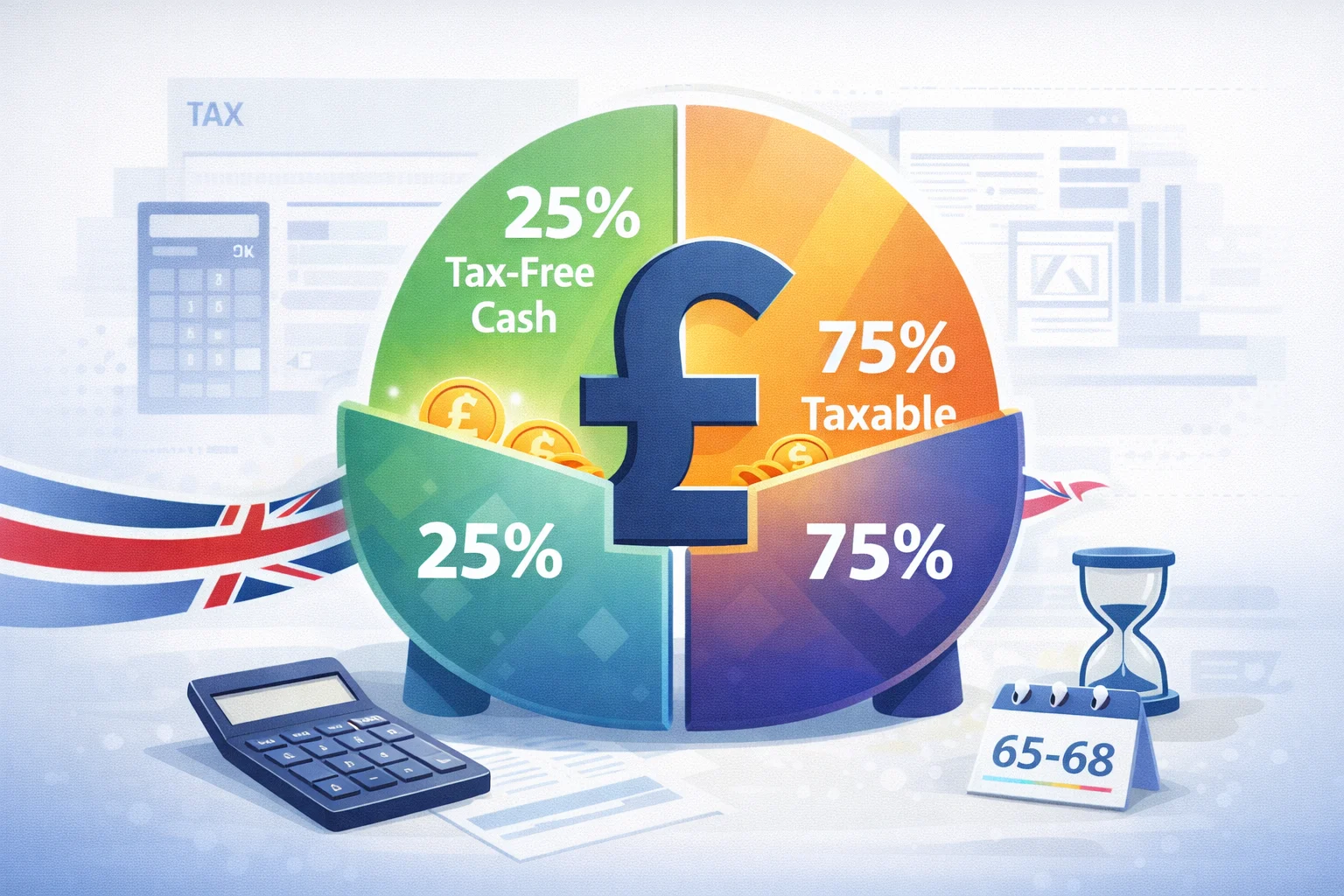
Understanding UFPLS - Flexible Pension Access
UFPLS (Uncrystallised Funds Pension Lump Sum) gives you the flexibility to take money from your pension pot from age 55 while keeping 25% tax-free. Our calculator helps you understand exactly how much you'll receive and what tax you'll pay.
£0
25% of withdrawal (tax-free)
£0
75% of withdrawal (taxable)
£0
After tax deductions
Income Tax Details
- Total Income Tax: £0
- Basic Rate Tax (20%): £0
- Higher Rate Tax (40%): £0
- Additional Rate Tax (45%): £0
- Emergency Tax Applied: £0
Income Summary
- Other Income: £0
- Taxable UFPLS (75%): £0
- Total Taxable Income: £0
- Your Tax Band: Basic Rate
- Effective Tax Rate: 0%
- Original Pension Pot: £0
- UFPLS Withdrawal: -£0
- Remaining Pension Pot: £0
- Remaining Tax-Free Cash: £0
Money Purchase Annual Allowance
Taking UFPLS triggers the MPAA, reducing your annual pension contribution allowance from £60,000 to £10,000 per year.
Annual Total
- Total UFPLS This Year: £0
- Total Tax-Free: £0
- Total Taxable: £0
- Total Tax Paid: £0
Net Position
- Total Net Received: £0
- Combined Total Income: £0
About Your UFPLS Calculation
This calculation is based on current UK tax rules for the 2024/25 tax year. The actual tax you pay depends on your total income for the year and your personal circumstances.
Important: This calculator is for estimation purposes only. For personalized advice about accessing your pension, consult a qualified financial advisor. You can find regulated advisors through the MoneyHelper retirement adviser directory.
How UFPLS Works
What is UFPLS?
UFPLS (Uncrystallised Funds Pension Lump Sum) allows you to take money from your pension pot flexibly from age 55 (rising to 57 in 2028).
- Each payment is automatically split: 25% tax-free and 75% taxable
- You can take as much or as little as you want, when you want
- No need to buy an annuity or set up drawdown first
- Remaining funds stay invested and can continue growing
- Different from taking your full 25% tax-free lump sum first
Tax Treatment
Understanding how UFPLS is taxed helps you plan withdrawals efficiently and minimize tax liability.
- 25% Tax-Free: Completely tax-free, no matter your income
- 75% Taxable: Added to your other income for the year
- Taxed at your marginal rate (20%, 40%, or 45%)
- First withdrawal may face emergency tax if no tax code provided
- You can reclaim emergency tax from HMRC
- Scottish taxpayers use Scottish tax bands
Key Considerations
Important factors to consider before taking UFPLS to ensure it's the right choice for your circumstances.
- Money Purchase Annual Allowance: Triggers £10,000 annual contribution limit
- Tax Planning: Large withdrawals can push you into higher tax bands
- Investment Growth: Remaining funds continue to grow tax-free
- Emergency Tax: Provide correct tax information to avoid overtaxation
- Lifetime Allowance: Abolished from April 2024, but lump sum limits apply
| Feature | UFPLS | Pension Drawdown |
|---|---|---|
| Tax-Free Cash | 25% of each withdrawal is tax-free | Usually take full 25% tax-free lump sum first |
| Flexibility | Take any amount at any time | Set up drawdown, then take regular or ad-hoc income |
| Tax Planning | Less control - every withdrawal is 75% taxable | Better control - manage tax-free and taxable separately |
| Complexity | Simple - just request withdrawals | More complex - requires crystallization process |
| Best For | Smaller pots, occasional withdrawals, simplicity | Larger pots, regular income, tax efficiency |
| Emergency Tax Risk | Higher risk on first withdrawal | Lower risk if tax code provided |
Which is better? For larger pension pots (over £100,000), drawdown often provides better tax efficiency. For smaller pots or occasional access, UFPLS offers simplicity. Consider consulting a financial advisor to determine the best approach for your situation.
England, Wales & Northern Ireland
| Band | Income Range | Tax Rate |
|---|---|---|
| Personal Allowance | £0 - £12,570 | 0% |
| Basic Rate | £12,571 - £50,270 | 20% |
| Higher Rate | £50,271 - £125,140 | 40% |
| Additional Rate | Over £125,140 | 45% |
Scotland
| Band | Income Range | Tax Rate |
|---|---|---|
| Personal Allowance | £0 - £12,570 | 0% |
| Starter Rate | £12,571 - £14,876 | 19% |
| Basic Rate | £14,877 - £26,561 | 20% |
| Intermediate Rate | £26,562 - £43,662 | 21% |
| Higher Rate | £43,663 - £75,000 | 42% |
| Advanced Rate | £75,001 - £125,140 | 45% |
| Top Rate | Over £125,140 | 48% |
Important: Your personal allowance reduces by £1 for every £2 earned over £100,000, completely eliminated at £125,140. This creates an effective 60% tax rate between £100,000-£125,140.
Money Purchase Annual Allowance (MPAA)
Once you take your first UFPLS payment, the MPAA is triggered, reducing your annual pension contribution allowance from £60,000 to just £10,000. This affects your ability to rebuild your pension through future contributions, so consider carefully before accessing funds if you plan to continue contributing.
Emergency Tax Risk
Your first UFPLS withdrawal often triggers emergency tax (tax code 1257L M1), which can result in significant overtaxation. To avoid this, provide your pension provider with your P45 from previous employment or ensure they have your correct tax code. You can reclaim overpaid emergency tax using HMRC form P55.
Tax Band Management
Large UFPLS withdrawals can push you into higher tax bands, especially if combined with other income. The 75% taxable portion is added to your total income for the year. Strategic planning of withdrawal timing and amounts can help minimize tax liability. Consider spreading withdrawals across multiple tax years if possible.
Investment Growth Opportunity
Funds remaining in your pension pot continue to be invested and can grow tax-free until you access them. Consider whether you need all the money now or if leaving some invested could provide better long-term outcomes. Our Private Pension Calculator can help model growth scenarios.
UFPLS stands for Uncrystallised Funds Pension Lump Sum, which is a flexible way to access your pension savings from age 55 (rising to 57 from 2028).
How it works:
- Each UFPLS payment you take is automatically split: 25% is completely tax-free and 75% is taxable as income
- You can take as much or as little as you want, whenever you want (subject to your pension scheme rules)
- You don't need to take your entire 25% tax-free cash first - it's automatically included in each withdrawal
- The remaining funds in your pension pot stay invested and continue to grow tax-free
- You can take UFPLS from multiple pension pots if you have them
Key differences from other options:
UFPLS is different from taking a pension commencement lump sum (PCLS) and then setting up drawdown. With UFPLS, you don't crystallise your pension - you take uncrystallised chunks. With drawdown, you typically take your full 25% tax-free cash first, then the remaining 75% stays invested and you draw taxable income separately.
Learn more about pension access options from MoneyHelper's pension guidance.
UFPLS taxation follows a simple split formula, but the overall tax you pay depends on your total income.
The Basic Split:
- 25% Tax-Free: This portion is completely tax-free, regardless of how much you earn from other sources
- 75% Taxable: This portion is added to your other income for the year and taxed at your marginal rate
Tax Rates (2024/25):
- Basic Rate (20%): On income between £12,571 and £50,270
- Higher Rate (40%): On income between £50,271 and £125,140
- Additional Rate (45%): On income over £125,140
Example:
If you withdraw £20,000 as UFPLS and have £30,000 other income:
- Tax-free portion: £5,000 (25% of £20,000) - no tax
- Taxable portion: £15,000 (75% of £20,000)
- Total income: £30,000 + £15,000 = £45,000
- Your total income of £45,000 falls in the basic rate band, so the £15,000 taxable UFPLS would be taxed at 20% = £3,000 tax
- Net amount received: £20,000 - £3,000 = £17,000
Important: Scottish taxpayers use different tax bands with rates ranging from 19% to 48%. The personal allowance (£12,570) reduces by £1 for every £2 earned over £100,000.
Emergency tax is a temporary tax treatment that often applies to your first UFPLS withdrawal, typically resulting in significant overtaxation.
Why Emergency Tax Occurs:
- Your pension provider doesn't have your current tax code from HMRC
- It's your first pension withdrawal and you haven't provided a P45
- HMRC's systems haven't yet updated your provider with your tax code
How Emergency Tax Works:
The emergency tax code (usually 1257L on a Month 1 basis) treats your UFPLS payment as if it's your regular monthly income for the entire year. For example, if you withdraw £12,000, the system assumes you'll earn £144,000 per year (£12,000 x 12 months), resulting in much higher tax than you actually owe.
How to Avoid Emergency Tax:
- Provide a P45: If you've recently stopped working, give your pension provider your P45 from your previous employer
- Contact HMRC: Before taking UFPLS, contact HMRC and ask them to send your tax code to your pension provider
- Complete form P46(PEN): Your pension provider should give you this form to help establish your correct tax code
How to Reclaim Emergency Tax:
- Form P55: If you've completely stopped working, complete this form to get a quick refund
- Form P50Z: If you're retired and only receiving pension income
- Self-Assessment: If you complete a tax return, claim the refund through this route
- Automatic Refund: HMRC should automatically refund you by the end of the tax year, but forms are faster
Most people get emergency tax refunded within 30 days of submitting the correct form. Download forms from GOV.UK.
Yes, you can take as many UFPLS payments as you wish from your pension pot, and each payment will automatically be split 25% tax-free and 75% taxable.
Benefits of Multiple Withdrawals:
- Tax Management: Taking smaller amounts across different tax years can help you stay in lower tax bands
- Flexibility: Only withdraw what you need, when you need it
- Investment Growth: Money left in your pension continues to grow tax-free
- Income Planning: Align withdrawals with your spending needs
Important Considerations:
- Money Purchase Annual Allowance: Your first UFPLS triggers the MPAA, reducing future pension contributions from £60,000 to £10,000 per year (this applies even if you only take one small payment)
- Tax Bands: Multiple large withdrawals in one tax year could push you into higher tax bands
- Emergency Tax: Usually only applies to the first withdrawal; subsequent ones should use your correct tax code
- Scheme Rules: Some pension schemes may have limits on frequency or minimum/maximum withdrawal amounts
Strategic Approach:
Many people take multiple smaller UFPLS payments rather than one large withdrawal to:
- Keep total taxable income within the basic rate band (under £50,270)
- Avoid losing personal allowance (which tapers between £100,000-£125,140)
- Spread tax liability across multiple tax years
- Maintain eligibility for income-related benefits if applicable
Consider using our calculator to model different withdrawal scenarios and see how they affect your tax position. For comprehensive retirement planning, our Private Pension Calculator can help you plan your overall pension strategy.
UFPLS and pension drawdown are both flexible ways to access your pension, but they work differently and suit different situations.
UFPLS (Uncrystallised Funds Pension Lump Sum):
- Each withdrawal is automatically 25% tax-free and 75% taxable
- Your pension remains "uncrystallised" - you haven't formally designated it for income
- Simple to arrange - just request withdrawals from your provider
- Less tax-efficient for larger pots due to the fixed 25/75 split
- Good for: smaller pension pots (under £100,000), occasional withdrawals, simplicity
Pension Drawdown:
- You typically take your full 25% tax-free lump sum first (up to £268,275 for 2024/25)
- The remaining 75% is "crystallised" and designated for drawdown
- You then take taxable income as needed from the crystallised portion
- More tax-efficient as you can control when and how much taxable income you take
- Good for: larger pension pots, regular income needs, tax planning flexibility
Key Differences Example:
Scenario: £200,000 pension pot, need £20,000 now
UFPLS Route:
- Take £20,000 UFPLS: £5,000 tax-free, £15,000 taxable
- £180,000 remains uncrystallised
- Still have access to 25% tax-free cash on remaining £180,000 (£45,000)
Drawdown Route:
- Take £50,000 tax-free lump sum (25% of £200,000)
- £150,000 moves to drawdown (fully taxable)
- Draw £20,000 from drawdown fund (all taxable)
- No more tax-free cash available from this pot
Which Should You Choose?
- Choose UFPLS if: You have a smaller pot, want simplicity, only need occasional withdrawals, or want to preserve access to tax-free cash
- Choose Drawdown if: You have a larger pot (over £100,000), need regular income, want maximum tax planning flexibility, or plan to take your full 25% tax-free cash
Important: Both options trigger the Money Purchase Annual Allowance (£10,000). You can use both methods - for example, UFPLS from one pension pot and drawdown from another. Consider getting financial advice to determine the best strategy for your circumstances.
Your remaining pension pot continues to be invested and can grow tax-free until you access it.
What Happens to Remaining Funds:
- Stays Invested: The money remains in your chosen pension investments (stocks, bonds, funds, etc.)
- Tax-Free Growth: Investment growth continues to be tax-free within the pension wrapper
- Available Tax-Free Cash: You still have access to 25% tax-free cash on the remaining balance (via future UFPLS or by moving to drawdown)
- Flexible Access: You can take more UFPLS payments whenever you want (subject to scheme rules)
- Can Convert to Drawdown: You can move remaining funds to drawdown at any time
Investment Considerations:
- Review your investment strategy - you might want less risky investments as you're drawing from the pot
- Consider sequencing risk - the risk that poor investment returns early in retirement can significantly reduce your pot
- Keep some funds in cash or stable investments to cover near-term withdrawals
- Regular reviews ensure your investments align with your withdrawal plans
Death Benefits:
- Before Age 75: Remaining funds can usually pass to beneficiaries tax-free
- After Age 75: Beneficiaries pay income tax at their marginal rate on withdrawals
- Uncrystallised funds (including remaining UFPLS money) are usually outside your estate for inheritance tax
- Keep beneficiary nominations up to date with your pension provider
Example:
If you have £100,000 and take £20,000 UFPLS:
- You receive: £5,000 tax-free + £15,000 taxable (minus income tax)
- Remaining pot: £80,000 stays invested
- Available tax-free cash: £20,000 (25% of £80,000) available for future withdrawals
- If pot grows to £85,000, your available tax-free cash increases to £21,250
Use our Private Pension Calculator to model how your remaining pension could grow over time and plan your withdrawal strategy accordingly.
Understanding Your State Pension
UFPLS applies to private and workplace pensions. Don't forget about your State Pension, which provides a foundation for retirement income.
- Check your State Pension forecast to see what you'll receive
- Learn about the UK State Pension system
- Find out how much you could receive
- Understand the minimum years needed for full State Pension
Comprehensive Retirement Planning
UFPLS is just one piece of your retirement income puzzle. Use our other calculators to build a complete picture:
- Pension Lump Sum Tax Calculator - Calculate tax on other lump sum types
- Tax Relief Calculator - Understand pension contribution benefits
- Workplace Pension Calculator - Project workplace pension growth
- Retirement Age Calculator - Plan when to retire
- Complete Pension Guide - Comprehensive retirement planning resource
Make Informed Pension Decisions
Understanding UFPLS taxation is crucial for maximizing your retirement income. Use our calculator to model different scenarios and plan your pension withdrawals strategically.