NHS Sick Pay Calculator 2025/26: Full Pay, Half Pay & SSP Entitlement
Calculate your exact NHS sick pay entitlement under Agenda for Change. See when full pay ends, half pay begins, and SSP takes over based on your service length and previous sickness history. Includes the rolling 12-month rule, net take-home estimates, and cut-off dates for each phase.
Understand Your NHS Sick Pay Entitlement
NHS occupational sick pay is far more generous than standard SSP, but the rolling 12-month rule and service-based tiers make it complex to calculate. Our tool factors in your previous sickness history to show exactly how much full pay and half pay you have remaining, plus the dates when each phase changes.
0 days
Ends: -
0 days
Ends: -
£118.75/week
Expires: -
- During Full Pay:£0/month
- During Half Pay:£0/month
- During SSP Only:£0/month
- Service Band:5+ years
- Total Full Pay Entitlement:6 months
- Total Half Pay Entitlement:6 months
- Previous Sickness Used:0 days
- WTE (Part-Time Factor):1.0
About This Estimate
This calculator provides estimates based on Section 14 of the Agenda for Change handbook. Actual entitlements may vary based on your Trust's local policies, shift patterns, and how unsocial hours are averaged during sick leave. SSP is included within NHS sick pay, not added on top. During half pay, you receive the higher of 50% salary or SSP (£118.75/week). Always verify with your HR department or check your Electronic Staff Record (ESR) for official figures.
How NHS Sick Pay Works
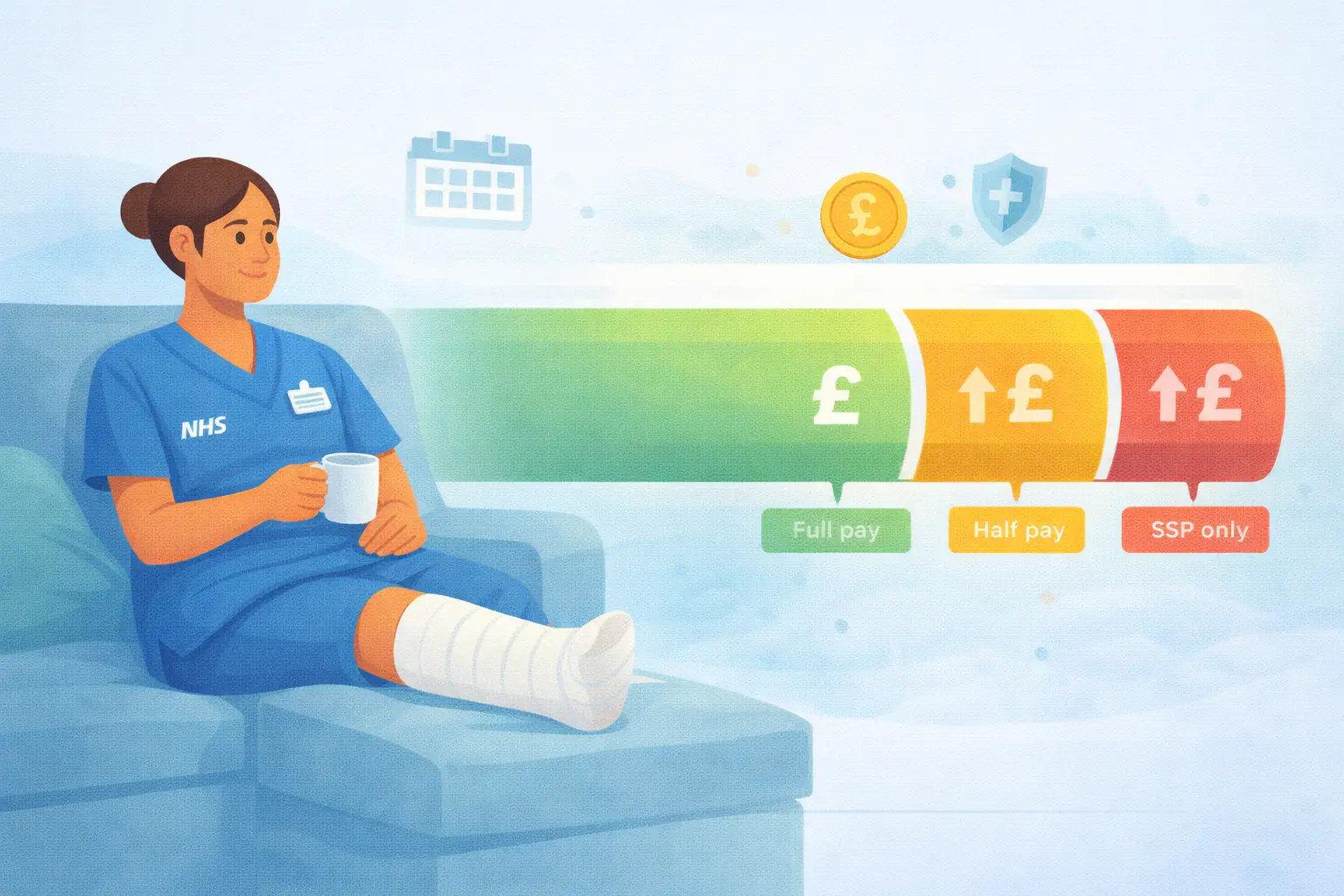
NHS occupational sick pay under Agenda for Change provides three phases of income protection. Your entitlement depends on your length of continuous service, not your pay band.
Full Pay
Your normal salary including contractual enhancements, unsocial hours, and HCAS. SSP is included within this amount, not added on top. Duration depends on service length: 1-6 months.
Half Pay
50% of your normal salary, but never less than the SSP rate (£118.75/week). This protection ensures your income does not fall below the statutory minimum. Duration: 1-6 months.
SSP Only
Statutory Sick Pay at £118.75 per week for up to 28 weeks total. After SSP ends, you can apply for Employment and Support Allowance or Universal Credit.
Entitlement is based entirely on continuous NHS service length, not your pay band. Band 2 and Band 9 staff with the same service receive identical entitlement periods.
| Continuous NHS Service | Full Pay | Half Pay | Total Occupational Sick Pay |
|---|---|---|---|
| Under 1 year | 1 month | 1 month | 2 months |
| 1 year | 1 month | 2 months | 3 months |
| 2 years | 2 months | 2 months | 4 months |
| 3 years | 4 months | 5 months | 9 months |
| 4 years | 5 months | 5 months | 10 months |
| 5+ years | 6 months | 6 months | 12 months |
Source: Section 14, Agenda for Change Handbook. Applies to all AfC staff in NHS England, NHS Scotland, and NHS Wales. After occupational sick pay ends, SSP continues for up to 28 weeks at £118.75/week (2025/26 rate).
How It Works
NHS sick pay entitlement is based on sickness taken in the past 365 days, not the calendar year or leave year. When you start a new period of sickness, your employer looks back 12 months from the first day of your current absence and counts all sick days within that window.
Any previous sick leave reduces your remaining full pay and half pay allowance. As older sickness passes the 12-month mark, your entitlement gradually restores.
Worked Example
A Band 6 nurse with 5+ years of service (6 months full + 6 months half) was sick for 3 months in March 2025. She falls ill again in November 2025:
- Looking back 12 months: 3 months already used from full pay
- Remaining full pay: 3 months
- Remaining half pay: 6 months (untouched)
By March 2026, the earlier absence drops off the 12-month window and the full 6 months of full pay is restored.
| SSP Element | 2025/26 Rate |
|---|---|
| Weekly SSP | £118.75 |
| Lower Earnings Limit | £125/week |
| Maximum Duration | 28 weeks |
| Waiting Days | First 3 qualifying days (unpaid) |
| Daily Rate (5 qualifying days) | £23.75 |
Key SSP Rules
- A Period of Incapacity for Work (PIW) must last at least 4 consecutive days for SSP to apply
- All calendar days count (including weekends and bank holidays)
- The 8-week linking rule: sickness periods separated by 56 days or less are treated as one continuous PIW
- Waiting days apply only once per linked PIW
- SSP is included within NHS pay during full and half pay periods, not added on top
- Bank staff and zero-hours workers qualify for SSP if earning at least £125/week
Full Pay Includes Enhancements
During full pay, you receive your normal salary including basic pay, contractual unsocial hours enhancements (usually averaged over a reference period), HCAS, and on-call allowances. The reference period for averaging variable payments is typically the previous 3 months, though this varies by Trust.
Pregnancy-Related Sickness
Sickness related to pregnancy is recorded separately and does not count toward your rolling 12-month entitlement. This protection exists under maternity discrimination legislation. If sickness occurs in the 4 weeks before your due date, it may trigger the start of maternity leave automatically.
Injury at Work (Section 22)
If your sickness results from a workplace injury or disease, Section 22 of the AfC handbook provides enhanced protection. You may receive up to 85% of pay through the Injury Allowance for up to 12 months. This sickness is also excluded from the rolling 12-month calculation for standard sick pay.
Documentation Requirements
Days 1-7: self-certification. From day 8: a fit note (Statement of Fitness for Work) is required from a GP, nurse, occupational therapist, physiotherapist, or pharmacist. Extended absences require regular fit notes and may involve occupational health review. You must notify your employer within their stated time limit (or 7 days if none specified).
Part-Time Staff
Part-time NHS staff receive the same entitlement periods (months of full/half pay) but the monetary amount is pro-rated by contracted hours. A 0.8 WTE employee receives 80% of full-time equivalent pay during sick leave. Pension contributions continue during paid sick leave.
When Sick Pay Runs Out
When occupational sick pay ends, SSP continues for up to 28 weeks. Your employer issues form SSP1 when SSP ends. You can apply for Employment and Support Allowance (ESA) or Universal Credit. If you cannot return to work, consider ill-health retirement through the NHS Pension Scheme. Our NHS Pension Calculator and Early Retirement Calculator can help model this.
NHS sick pay under Agenda for Change provides income protection in three phases. First, you receive full pay (your normal salary including enhancements) for a period based on your service length. Then half pay (50% of salary, never below SSP). Then SSP only at £118.75/week for up to 28 weeks. SSP is included within NHS pay during full and half pay, not added on top. Entitlement ranges from 1 month full + 1 month half (under 1 year of service) up to 6 months full + 6 months half (5+ years). The rolling 12-month rule means any sick leave in the past year reduces your remaining allowance.
No. The entitlement periods (months of full pay and half pay) are identical for all Agenda for Change bands from Band 2 to Band 9. The sole determining factor is your length of continuous NHS service. However, the monetary amount differs because full pay and half pay are calculated as a percentage of your actual salary. A Band 7 on half pay receives more money than a Band 3 on half pay, but both have the same number of months.
When you start a new sickness absence, your employer looks back exactly 365 days and counts all sick leave within that window. This amount is deducted from your total entitlement. For example, if you have 5+ years of service (6 months full + 6 months half) and already used 2 months of full pay in the past year, only 4 months of full pay remain. As older absences pass the 12-month mark, your entitlement gradually restores. Pregnancy-related sickness and injury at work are excluded from this calculation. This rule is defined in Section 14 of the Agenda for Change handbook.
Statutory Sick Pay for 2025/26 is £118.75 per week. You must earn at least £125 per week to qualify. SSP has 3 waiting days (unpaid) before payments begin. A Period of Incapacity for Work must last at least 4 consecutive days. If two sickness periods are separated by 8 weeks (56 days) or less, they are linked and treated as one continuous period. SSP can last up to 28 weeks. When SSP expires, your employer issues form SSP1 and you can apply for ESA or Universal Credit.
When occupational sick pay ends, SSP continues for up to 28 weeks total. When SSP ends, your employer issues form SSP1. You can apply for Employment and Support Allowance (ESA) or Universal Credit through Jobcentre Plus. If you cannot return to work, you may consider ill-health retirement through the NHS Pension Scheme using forms AW33E (tier 1, reduced duties) or AW240 (tier 2, permanent incapacity). You continue to accrue annual leave during paid sick leave, and your NHS pension membership is maintained. Speak to your HR department and consider seeking advice from your union (RCN, Unison, Unite).
For absences of 7 days or fewer, you can self-certify. From day 8 onwards, you need a fit note (Statement of Fitness for Work) from a GP, hospital doctor, registered nurse, occupational therapist, physiotherapist, or pharmacist. Fit notes can state "not fit for work" or "may be fit for work" with workplace adjustments. Extended absences require regular fit note renewals and may trigger occupational health assessment. You must notify your employer within their stated time limit, or within 7 days if no specific limit exists.
NHS bank workers without permanent contracts typically receive SSP only, not occupational sick pay. To qualify for SSP, bank staff must earn at least £125 per week on average and be unable to work for 4 or more consecutive days. Agency workers and zero-hours contract employees are also entitled to SSP if they meet the earnings threshold. Bank staff do not generally build continuity of service between shifts, so they do not accrue the service-based entitlements that permanent staff receive. If you hold both a substantive contract and a bank contract with the same employer, they are treated as separate contracts with different entitlements.
Plan Your Finances During Sickness Absence
Knowing exactly when full pay ends and half pay begins helps you budget effectively and reduce financial stress during illness. Use our calculator to see your complete sick pay timeline and net take-home at each stage.