Pension Tax Calculator
The complete UK pension tax tool. Calculate tax relief on contributions, check your annual allowance, compare salary sacrifice savings, and estimate tax on pension withdrawals — all in one place. Updated for the 2026/27 tax year.
Pension Tax Made Simple
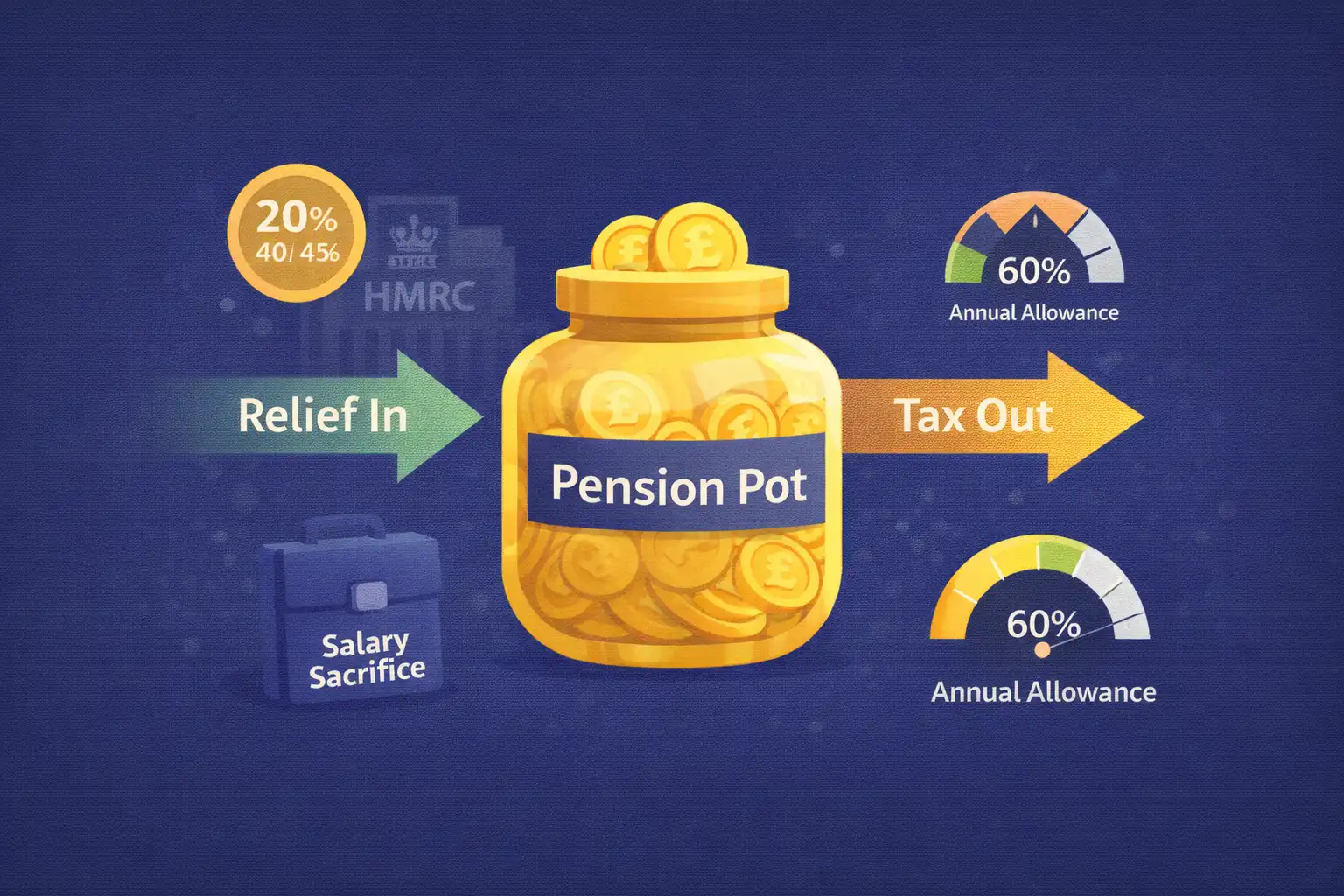
Pension tax involves two sides: tax relief going in (the government topping up your contributions) and tax coming out (income tax on your withdrawals). Understanding both sides — plus rules around annual allowances, salary sacrifice, and the personal allowance taper — can save you thousands.
- Your Gross Contribution:£0
- You Actually Pay:£0
- Basic Rate Relief (20%):£0
- Higher/Additional Relief:£0
- NI Saving (Salary Sacrifice):£0
- Total Tax Benefit:£0
- Effective Cost per £1 in Pension:£0.80
- Your Contributions:£0
- Employer Contributions:£0
- Total Pension Input:£0
- Your Annual Allowance:£60,000
- Carry Forward Available:£0
- Allowance Remaining:0
- Withdrawal Amount:£0
- Tax-Free (25%):£0
- Taxable Amount:£0
- Income Tax on Withdrawal:£0
- You Receive:£0
About This Calculation
This calculator uses 2026/27 income tax rates and pension rules. Results are estimates. Tax relief depends on your specific circumstances, contribution method, and how you claim relief. Employer contributions don't attract personal tax relief but count towards your annual allowance. For detailed guidance, consult HMRC's pension tax guide or the MoneyHelper pension tax pages. For personalised advice, consider consulting a FCA-regulated financial adviser.
How UK Pension Tax Works
Pension tax in the UK has two sides — a generous incentive when you contribute and an income tax charge when you withdraw. Understanding both sides, along with the rules around allowances, is essential for maximising your retirement savings.
Tax Relief Going In
When you contribute to a registered pension, the government adds back the income tax you paid on that money. Basic rate taxpayers receive 20% relief automatically. Higher rate (40%) and additional rate (45%) taxpayers can claim extra relief through Self Assessment.
For a higher rate taxpayer, every £1,000 in your pension effectively costs just £600 after all relief is claimed. This is one of the most powerful tax benefits in the UK. Use our Pension Tax Relief Calculator for detailed relief calculations.
Tax-Free Growth
Once inside your pension, your investments grow completely free of income tax and capital gains tax. There is no annual tax on dividends, interest, or capital gains within the pension wrapper. This tax-sheltered growth is a significant advantage over investing outside a pension or ISA.
Since the Lifetime Allowance was abolished from April 2024, there is no longer any limit on how large your pension pot can grow without triggering additional tax charges.
Tax on Withdrawals
When you access your pension from age 55 (rising to 57 in 2028), you can take 25% as a tax-free lump sum (capped at £268,275). The remaining 75% is taxed as income at your marginal rate via PAYE.
For most people, their marginal rate in retirement is lower than during their working years — meaning you pay less tax getting money out than the relief you received putting it in. This is the fundamental advantage. For detailed withdrawal scenarios, use our Pension Lump Sum Tax Calculator.
Standard Annual Allowance
The annual allowance for 2026/27 is £60,000. This is the maximum total pension contributions (yours plus your employer's) that benefit from tax relief in a single tax year. If you exceed this limit, you face an Annual Allowance Charge taxed at your marginal rate. Contributions include everything going into all your pension schemes — personal contributions, employer contributions, and any contributions from third parties.
You can carry forward unused annual allowance from the previous three tax years, provided you were a member of a registered pension scheme. You must use the current year's allowance first. This can allow contributions up to £240,000 in a single year. For HMRC-specific guidance, use our HMRC Pension Tax Calculator.
Tapered Annual Allowance
If your "adjusted income" (broadly, total income including employer pension contributions) exceeds £260,000, your annual allowance is reduced by £1 for every £2 above £260,000, down to a minimum of £10,000. This means anyone with adjusted income of £360,000 or more has an annual allowance of just £10,000.
The taper only applies if your "threshold income" (broadly, income excluding employer pension contributions) also exceeds £200,000. This two-test system protects people who have modest personal income but large employer contributions. For NHS staff affected by the taper, see our NHS Pension Calculator and NHS Tax Calculator.
MPAA (£10,000)
Once you flexibly access your defined contribution pension (taking taxable income, not just the 25% tax-free cash), the Money Purchase Annual Allowance of £10,000 applies to all future money purchase contributions. This is a permanent restriction — it cannot be reversed. Taking only your 25% tax-free lump sum without touching the remaining 75% does not trigger the MPAA.
Relief at Source
With relief at source, you contribute from your net (after-tax) pay. Your pension provider claims 20% basic rate relief from HMRC and adds it to your pot. If you're a higher or additional rate taxpayer, you must claim the extra 20% or 25% through your Self Assessment tax return. This method is used by most personal pensions, SIPPs, and schemes like NEST.
A common mistake: many higher rate taxpayers fail to claim their extra relief, leaving significant money unclaimed each year. HMRC estimates that over £1 billion in higher rate pension tax relief goes unclaimed annually.
Salary Sacrifice
With salary sacrifice, you agree to reduce your contractual salary, and your employer makes the equivalent pension contribution instead. Because the contribution never forms part of your salary, you save both income tax and National Insurance (8% for employees) on the sacrificed amount. Your employer also saves employer NI (15%), and may share this saving with you.
For a higher rate taxpayer sacrificing £1,000: the total saving is approximately £480 (£400 tax plus £80 NI) — compared to £400 via relief at source. The extra NI saving makes salary sacrifice the more efficient option where available. Check your scheme with our Employer Pension Contribution Calculator.
| Feature | Relief at Source | Salary Sacrifice | Net Pay |
|---|---|---|---|
| Income Tax Relief | 20% auto, claim extra via SA | Full relief automatic | Full relief automatic |
| Employee NI Saving | No | Yes (8% / 2%) | No |
| Employer NI Saving | No | Yes (15%) | No |
| Must Claim via SA? | Yes (higher/additional) | No | No |
| Common With | SIPPs, NEST, personal pensions | Workplace schemes | Public sector (NHS, teachers) |
The £100K Personal Allowance Trap
Earning between £100,000 and £125,140 triggers the Personal Allowance taper — an effective 60% marginal tax rate. Pension contributions reduce your adjusted net income, so contributing enough to drop below £100,000 restores the full £12,570 allowance. This means pension contributions in this range effectively receive 60% tax relief — the best deal in the UK tax system. Our Pension Tax Relief Calculator shows the exact saving.
Timing Withdrawals Across Tax Years
Large one-off pension withdrawals can push you into higher tax bands. Spreading withdrawals across multiple tax years keeps you in lower bands and maximises your Personal Allowance each year. If your only income is pension withdrawals, you can take approximately £16,760 tax-free each year (£12,570 Personal Allowance plus 25% tax-free on each withdrawal). Plan your drawdown carefully using our Pension Lump Sum Tax Calculator.
State Pension and Tax
The full new State Pension (£230.25/week, £11,973/year for 2025/26) is below the Personal Allowance and untaxed alone. But once combined with private pension income, the total often exceeds £12,570, making all additional pension withdrawals taxable from the first pound. Factor your State Pension into withdrawal planning using our State Pension Calculator.
Pension Transfers & Tax
If you're considering transferring a defined benefit pension, a CETV offers the capital value of your guaranteed benefits. Transfers over £30,000 require FCA-regulated financial advice by law. Be cautious of scams — check the FCA Warning List. Use our CETV Calculator to understand your transfer value.
When you contribute to a registered pension scheme, the government gives back the income tax you paid on that money. Basic rate taxpayers (20%) get relief added automatically. Higher rate (40%) and additional rate (45%) taxpayers claim extra relief through Self Assessment. For every £100 gross contribution, a basic rate taxpayer pays £80, a higher rate taxpayer effectively pays £60, and an additional rate taxpayer pays £55.
Workplace pensions using "net pay" arrangements (common in the NHS, teaching, and civil service) deduct contributions before tax is calculated, providing relief automatically at your full marginal rate. For relief at source pensions, the provider claims 20% from HMRC, and you claim the rest. Learn more with our Pension Tax Relief Calculator.
The standard annual allowance is £60,000 for 2026/27. This includes both your personal contributions and any employer contributions across all your pension schemes. If your adjusted income exceeds £260,000, the tapered annual allowance reduces your limit by £1 for every £2 above £260,000, to a minimum of £10,000.
If you have accessed your pension flexibly (taken taxable income, not just the 25% tax-free cash), the Money Purchase Annual Allowance of £10,000 applies. You can carry forward unused allowance from the previous three years if you were a registered scheme member. Check your position with our HMRC Pension Tax Calculator.
You can take 25% of your pension tax-free (up to £268,275). The remaining 75% is taxed as income at your marginal rate. Tax is deducted via PAYE by your provider. If they don't have your tax code, they may apply emergency tax — assuming the withdrawal repeats monthly — resulting in much higher deductions than necessary.
You can reclaim overpaid emergency tax through HMRC forms P55 or P53Z. Spreading withdrawals across tax years keeps you in lower brackets. For detailed scenarios, use our Pension Lump Sum Tax Calculator.
With relief at source, you pay from net pay and the provider claims 20% from HMRC. Higher rate taxpayers must claim extra via Self Assessment. With salary sacrifice, your salary is reduced before tax and NI, saving both income tax and National Insurance (8%) on the sacrificed amount. Salary sacrifice is more efficient but only available through workplace schemes.
For example, a higher rate taxpayer contributing £1,000 gross saves approximately £400 via relief at source but approximately £480 via salary sacrifice (the extra £80 is the NI saving). Your employer also saves 15% employer NI, which they may share with you. Check your scheme details with your employer or use our Employer Pension Contribution Calculator.
If total pension contributions exceed your annual allowance (including carried forward amounts), you face an Annual Allowance Charge taxed at your marginal rate. You must report the excess on your Self Assessment return. For charges exceeding £2,000, you may use "Scheme Pays" — asking your pension scheme to pay the charge from your pot, reducing future benefits but avoiding an immediate cash payment.
This is particularly relevant for NHS staff and teachers in defined benefit schemes where pension growth is measured as "pension input amount" rather than actual contributions. Growth above the annual allowance triggers the charge even if you haven't changed your contribution rate.
Yes. You can carry forward unused annual allowance from the previous three tax years, provided you were a member of a registered pension scheme during those years. You must use the current year's £60,000 first. This can allow contributions up to £240,000 in a single year if all four years' allowances are fully available.
Carry forward is particularly useful after receiving a bonus, inheritance, or property sale proceeds that you want to shelter in your pension. Note that you can only contribute up to 100% of your relevant UK earnings in any year (or £3,600 if not earning), regardless of carry forward availability.
If your adjusted net income exceeds £100,000, your Personal Allowance of £12,570 is reduced by £1 for every £2 above £100,000 — an effective 60% marginal tax rate between £100,000 and £125,140. Pension contributions reduce your adjusted net income, so contributing enough to drop below £100,000 restores the full allowance.
For someone earning £125,000, a £25,000 pension contribution would bring adjusted income to £100,000, saving approximately £5,000 in tax from the restored Personal Allowance alone — on top of the 40% tax relief on the contribution itself. This makes pension contributions in this range extraordinarily tax-efficient.
No. The Lifetime Allowance was abolished from 6 April 2024. There is no longer a limit on total pension savings without incurring tax charges. However, the tax-free lump sum remains capped at 25% of your pot up to a maximum of £268,275. Existing LTA protections (Enhanced, Fixed, Individual) may still be relevant for determining a higher maximum tax-free lump sum.
The focus has now shifted entirely to managing the annual allowance and planning tax-efficient withdrawals. For comprehensive retirement planning, explore our Pension Calculator, Retirement Age Calculator, and Savings Calculator.
Pension Tax Relief Calculator
Deep-dive into how much relief you receive at different tax rates.
Calculate ReliefPension Lump Sum Tax
Work out tax on your pension withdrawal with emergency tax scenarios.
Check Withdrawal TaxMake Every Pound Work Harder for Your Retirement
Understanding pension tax is the key to maximising your retirement savings. Whether you're building your pot or planning withdrawals, the right tax strategy can save you thousands over your lifetime.
Disclaimer
This calculator provides estimates based on 2026/27 HMRC pension tax rules and income tax rates. Your actual position may vary based on your complete financial circumstances, contribution method, scheme type, and how you claim relief. This tool does not constitute financial or tax advice. For complex situations — particularly involving the tapered annual allowance, defined benefit scheme pension input amounts, or large withdrawals — consult a qualified financial adviser. Sources: HMRC Pension Tax, Annual Allowance, MoneyHelper, The Pensions Regulator.